Top 10 Trademark Printing Machines You Should Know About?
In today's competitive market, a reliable Trademark Printing Machine is crucial for businesses. These machines help create distinctive brands. They play a vital role in logo creation, packaging, and merchandise. Understanding their features can enhance your business strategy.
Choosing the right Trademark Printing Machine can be daunting. The options available vary significantly in quality and capability. Each machine has its unique strengths. Some excel in speed, while others focus on detail. You might need to test a few before finding the perfect match.
Learning about the top models can save time and effort. Some are known for efficiency and reliability. Others may not live up to expectations. Therefore, awareness of potential pitfalls is essential. Reflecting on your specific needs will lead you to the right choice. Embracing this knowledge can set your brand apart in the marketplace.
Overview of Trademark Printing Machines and Their Importance
Trademark printing machines play a critical role in brand identity and product differentiation. They enable businesses to produce high-quality labels and packaging. According to a recent industry report, the demand for custom labeling solutions has surged by over 20% in the past year. This trend highlights the urgency for companies to adopt advanced printing technologies.
The proliferation of e-commerce has intensified competition among brands. Effective trademark printing ensures that products stand out on crowded online shelves. A study from Smithers Pira reveals that 70% of consumers base their purchase decisions on packaging design. This statistic underscores the necessity for businesses to invest in reliable printing machines. However, choosing the right technology can be daunting due to varying quality levels and features.
Many companies seek budget-friendly solutions. Yet, compromising on quality can lead to poor brand perception. Consider the potential fallout of low-resolution prints or fading colors. These issues can erode consumer trust. Investing in reputable machines generally leads to longer-lasting results and better brand loyalty. It’s crucial to weigh the long-term benefits against short-term savings in this competitive landscape.
Top 10 Trademark Printing Machines You Should Know About
| Machine Model |
Print Technology |
Max Print Width |
Print Speed |
Key Features |
| Model A |
Inkjet |
24 inches |
30 prints/min |
High resolution, eco-friendly inks |
| Model B |
Laser |
36 inches |
25 prints/min |
Durable prints, fast warm-up time |
| Model C |
Thermal Transfer |
12 inches |
20 prints/min |
Long-lasting prints, precise color control |
| Model D |
Digital |
48 inches |
15 prints/min |
Versatile media handling, vivid colors |
| Model E |
Wide Format |
60 inches |
10 prints/min |
High volume production, professional graphics |
| Model F |
Direct-to-Garment |
24 inches |
50 prints/hour |
Ideal for custom apparel, detailed prints |
| Model G |
UV Printer |
30 inches |
18 prints/min |
Prints on various surfaces, instant drying |
| Model H |
Sublimation |
42 inches |
22 prints/min |
Bright colors, soft feel on fabrics |
| Model I |
Flexo |
24 inches |
12 prints/min |
Fast setup, low-cost printing |
| Model J |
Screen Printing |
36 inches |
15 prints/min |
Ideal for bulk orders, thick ink deposits |
Key Features to Consider When Choosing a Trademark Printing Machine
Choosing the right trademark printing machine can be a daunting task. Various features significantly impact the machine's performance. One crucial aspect is printing speed. Machines with higher speeds can boost productivity. However, they may come with a larger price tag. It's vital to assess your needs and find a balance between speed and budget.
Print resolution is another key feature. A machine that offers high resolution will produce sharper images and text. If your work requires precise detail, prioritize machines with advanced technology. It is important to consider the media types you intend to use. Not all machines can handle diverse materials, so check compatibility.
User-friendliness can’t be overlooked. Machines with complex interfaces may lead to frustration. Look for models with intuitive controls. Maintenance requirements also deserve attention. A reliable machine should be easy to clean and service. Regular maintenance can prolong its lifespan. Evaluate your options carefully, and reflect on your specific requirements before making a decision.
Top 10 Trademark Printing Machines: A Comprehensive Review
When selecting a trademark printing machine, understanding the technology is crucial. These machines can vary significantly in performance and features. You want a reliable machine that delivers high-quality prints consistently. Look for options that offer versatility in printing different materials.
Tips: Always check the specifications before purchasing. Look for machines that accommodate various sizes and types of print media. This flexibility can save time and resources. Don’t overlook customer reviews; they provide insight into the machine's reliability and ease of use.
Maintenance is another important aspect. Regular cleaning and servicing can extend the life of your machine. Some users underestimate the need for routine checks. This can lead to unexpected issues and downtime. A machine that is well-cared for will deliver better performance over its lifespan.
Consider the level of support you require. Some machines come with extensive manuals, while others may rely on user experience. If you feel uncertain, choose a machine with adequate support resources available. Understanding your needs is vital in making the right choice.
Comparison of Popular Brands in Trademark Printing Technology
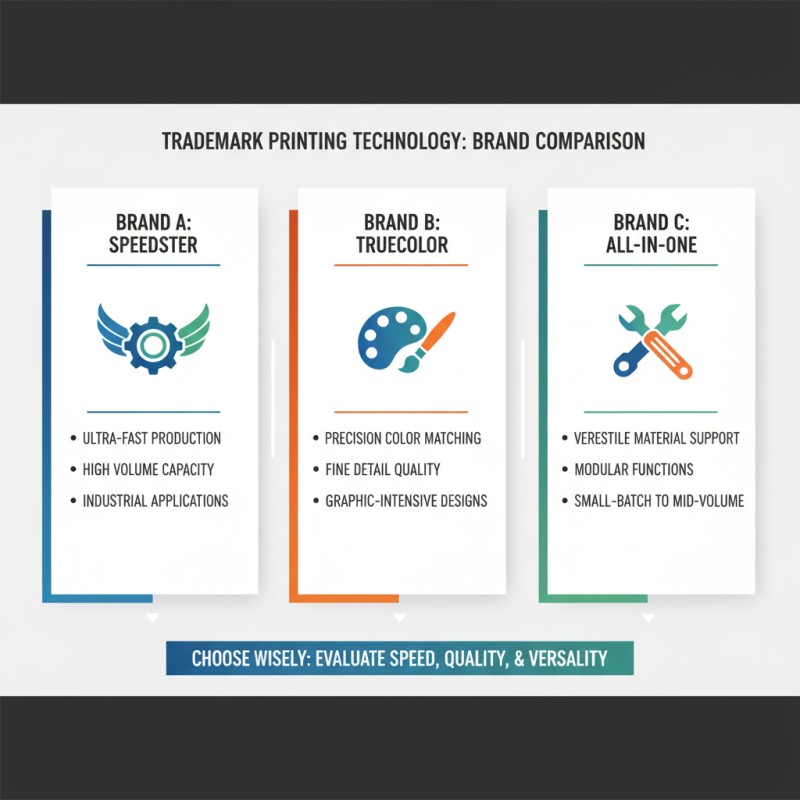
When exploring trademark printing technology, it’s essential to understand the wide range of brands available. Each brand offers unique features, catering to various printing needs. The differences can be subtle yet impactful. Some machines excel in speed, while others focus on print quality. Choosing the right one involves carefully evaluating these factors.
Comparing popular brands reveals distinct strengths and weaknesses. Some machines require more maintenance, while others boast user-friendly interfaces. Operators may find themselves frustrated with complex setups. Additionally, not all machines are suited for high-volume production; efficiency can vary significantly between models. Investing time in research could lead to a better long-term choice.
Effective trademark printing also hinges on the materials used. Some brands support a broader range of substrates, enhancing versatility. However, not all machines accommodate thicker materials. This limitation can restrict creative applications. In this evolving field, staying informed about trends will empower businesses to make smarter purchasing decisions.
Future Trends in Trademark Printing Machine Development
The future of trademark printing machines is evolving rapidly. Industry reports predict a significant growth in this sector. By 2025, the market for these machines is expected to reach $7 billion, driven by advancements in technology. Innovations such as digital printing, automation, and eco-friendly inks are shaping the industry.
Digital printing technology is leading the way. Its flexibility allows for quicker production times and lower costs. Companies are able to customize trademarks easily and efficiently. Automated processes are reducing human error, enhancing reliability. However, some manufacturers still struggle with integration, which requires reflection on operational strategies.
Sustainability is also becoming a priority. Many manufacturers are investing in eco-friendly materials and practices. A recent study indicated that 60% of consumers prefer products that are sustainably produced. The challenge lies in maintaining cost-effectiveness while adopting these green practices. As the industry moves forward, balancing innovation with environmental responsibility will be essential.
Top 10 Trademark Printing Machines: Features Comparison